Although we’re nearing the end of 2018, our pick for the best gaming monitor hasn’t changed. The best gaming monitor is the Asus ROG Swift PG279Q. It combines 1440p with 144Hz refresh rate, overclockable to 165Hz, and has G-Sync to keep your gameplay smooth.
Asus and Acer have recently (finally!) launched new 27-inch 4K HDR 144Hz G-Sync monitors—essentially 4K HDR versions of our top pick here. Those monitors are fantastic, but they also cost around $2,000. Unless you just won the lottery and have a mountain of cash to burn, we stand by our recommendation of the Asus PG279Q.
The great thing about displays is that, unlike graphics cards where their lifespan is usually a few years, a good display can keep you going for the better part of a decade. With such a long lifespan, it pays to get something you’ll be happy with for years to come. We’ll discuss the technologies and features that make for a good gaming display, why they matter, and we have several options for a variety of price points. Right now, these are the best monitors for PC gaming.
1. ASUS ROG Swift PG279Q
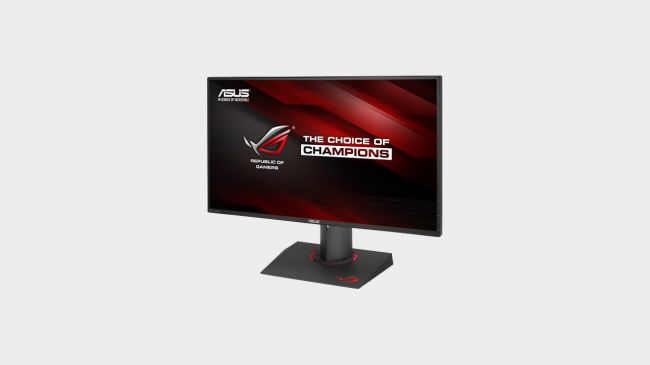
The Asus ROG Swift PG279Q is the best gaming monitor you can buy right now. For years, gamers have been forced to make a choice between picture quality and refresh rate. Cheaper, faster TN panels delivered fast refresh speeds up to 144Hz, while IPS screens offered more vibrant colors and dramatically better viewing angles, but at much slower refresh rates. But as monitor technology has improved, there are now monitors that pair an IPS screen with a 144Hz refresh rate.
The PG279Q is a 27-inch monitor with a 2560×1440 resolution, which we currently consider the sweet spot for high-end gaming. It offers substantially more pixels than 1080p without being as demanding as a 4K panel, meaning games look sharp at 27 inches but won’t bring a good GPU to its knees. Plus, you can still get higher than 60Hz refresh rates, which isn’t possible on the current crop of 4K displays. You can also comfortably run at 100 percent scaling in Windows, something that isn’t always desirable with 4K panels.
Like its primary competitor, the Acer Predator XB271HU, the PG279Q is an IPS panel with a refresh rate that can be overclocked up to 165Hz. (The difference between 144Hz and 165Hz is mostly negligible though.) Inputs include DisplayPort 1.2a as well as HDMI 1.4 (one of each), a nice addition over our previous best monitor pick. Both displays also feature Nvidia’s G-Sync technology for variable refresh rates, assuming you’re using an Nvidia GPU. If you’re an AMD user, however, you won’t benefit from G-Sync and should consider a FreeSync monitor instead. Our pick for that is below.
The biggest drawback to such a fine monitor, of course, is the price. The PG279Q can be found for less than $800/£700, but not by much. Having said that, we consider a monitor an investment. Don’t buy something cheap you’ll want to replace in two years. Buy a great monitor that will still be going strong half a decade from now. There are 144Hz IPS monitors similar to Asus’s offering, only with FreeSync instead of G-Sync, but the Asus ROG Swift PG279Q is the best choice and worth every dollar.
2. Acer Predator X27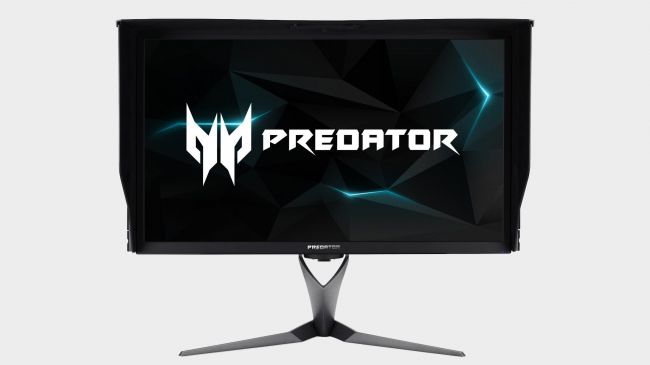
Up until recently, gamers had to choose between high resolution and high refresh rate. Monitors with 120Hz or higher refresh rates were limited to 1440p panels, while 4K screens topped out at 60Hz. That is until the Acer Predator X27 and Asus PG27UQ launched. Both monitors are absolutely fantastic, with 4K resolution, HDR, G-Sync, and a high refresh rate. They’re also prohibitively expensive, at around $2,000 apiece.
Marrying an IPS panel to a refresh rate of up to 144Hz when overclocked, the Acer Predator X27 is a site for sore (or sensitive) eyes. Its integration of VisionCare technology, the company says, will prevent eye strain and tiredness during extensive gameplay sessions. G-Sync allows the monitor to refresh at a variable rate instead of being locked to its max (in this case, 144Hz). It syncs the monitor’s refresh rate to your framerate in-game, eliminating microstutter or screen tearing when your framerate doesn’t match up perfectly to that high 144Hz demand. In regard to connectivity, the Acer Predator X27 welcomes a number of ports on its left and rear. On the side are two USB 3.0 ports while the backside it home to an additional two USB 3.0 ports as well as HDMI 2.0 and DisplayPort 1.4 out.
Despite the high asking price, both the X27 and the PG 27UQ are absolutely worth considering, but we’re giving the nod here to the Acer X27. The two monitors are nearly identical, but, trivial as it may seem, we like the stand on the X27 more. That said, if either monitor is on sale, go for the one with the lower price tag. They’re both outstanding.
3. ASUS MG279Q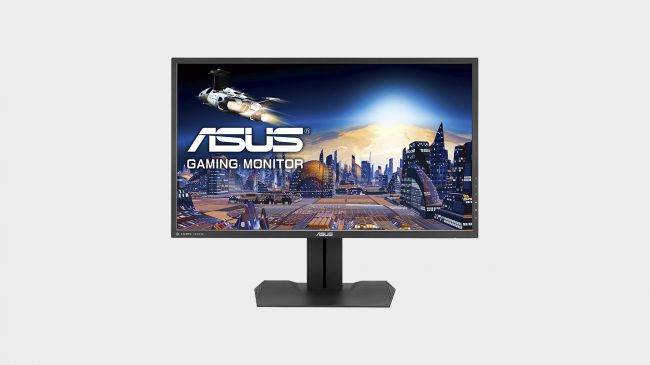
Right now there’s really no competition for the Asus MG279Q: this is absolutely the best monitor for AMD users who want a FreeSync display. It’s a 1440p IPS screen that can refresh up to 144Hz, like our favorite monitor above. But because it uses the open FreeSync technology instead of G-Sync, it doesn’t cost as much (though price differences have narrowed of late).
Thanks to that IPS screen, colors look great even from off-angles. The base is sturdy (and allows for lots of tilting, pivoting, and height adjustments) and the bezel is fairly thin, which is nice for a 27-inch monitor that’s already taking up a good deal of space. Like most other gaming displays, it also has a light anti-gloss coating, which I like; some older IPS displays went too heavy on the coating and affected image quality, but the MG279Q doesn’t have that problem.
The contrast ratio is also great, and the ability to support multiple inputs makes this screen better for people who might want to connect a second system, like a gaming console. This is thanks to the presence of the internal scaler, one of the main differences you’ll find between G-Sync and FreeSync offerings. With no other IPS FreeSync displays that can match the MG279Q on specs, this is a great monitor and an easy choice for anyone with an AMD graphics card.
4. Acer XR382CQK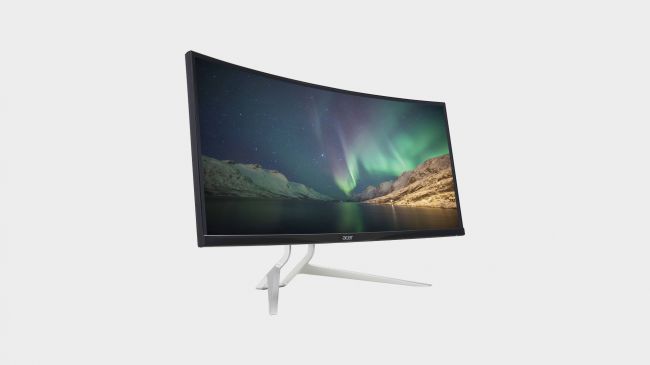
If your mantra for displays is to go big or go home, Acer hears you and its XR382CQK is a massive 38-inch curved screen that looks absolutely stunning. It features a QHD ultrawide panel with a 3840×1600 resolution, with an aspect ratio of 24:10 that’s slightly wider than the ‘standard’ 21:9 AR seen on other UW displays. The IPS panel looks great, and the size means gaming from the comfort of your couch is a viable option.
Not content to end there, the display also features FreeSync technology with up to 75Hz variable refresh rates. It’s a big, bold, and beautiful looking display, and the zero-frame bezel-less approach is another welcome addition. If you’re looking for something to really turn heads, this is the best widescreen gaming monitor. And boy, is it wide.
The 38-inch (technically 37.5-inch) span across its diagonal results in a 35-inch width, with a 14.5-inch height, and that’s not including the stand. It’s taller than the 27-inch 16:9 displays mentioned above, and nearly half again as wide, but the higher resolution means the dot pitch is actually slightly lower than that of the lesser displays. And for games that properly support ultrawide resolutions, the surround effect of the XR382CQK is incredibly immersive—sitting at your desk, the 38-inch panel completely fills your field of view.
The cost for the best ultrawide display is steep, but at least you won’t need to upgrade again for many years. Over $1000 for the XR382CQK may be a bitter pill to swallow, but the beauty of this screen will wash away the nasty taste in your mouth the instant you boot up your favorite games in 21:9 glory. And barring hardware failure, this display should keep you gaming happily until 2025.

 Best Gaming Monitors